AI receptionists for loan officers: what they can and can't do
An honest guide to AI receptionists for loan officers: what they answer, what they must never say, consent rules, costs and hand-offs.
 Dana WhitfieldAI Engine and follow-up specialist, Mortgage Website ShopPublished · Updated · 6 min read
KEY TAKEAWAYS
- An AI receptionist is best at the first conversation: greeting, general answers, collecting details and booking time with a licensed loan officer.
- It must never quote rates, approve loans or give personalised advice, and it should say it is an AI.
- Call-recording consent rules vary by state; outbound AI calling needs prior express consent under the TCPA.
- Judge it by coverage and hand-off quality, not by promises of accuracy percentages or lead lifts.
An AI receptionist for a loan officer is a voice assistant that answers your phone when you cannot: it greets the caller, says it is an AI, answers general questions from content you have approved, collects details and books time with you. It is not a loan officer and should never act like one.
That distinction is the whole game. Used well, an AI receptionist means fewer missed calls and better-prepared conversations. Used badly, it quotes rates it should not, frustrates callers and creates compliance risk. This guide covers both sides.
hours of coverage, including evenings when many borrowers research
Capability, not a performance claim
average 30-year fixed rate: a reason callers ask about rates (which the AI must not quote)
Freddie Mac PMMS, 2026-10-15
active loan originators in 2025 competing to be the one who answers
MBA Chart of the Week (NMLS data), 2025-09
What does an AI receptionist actually do?
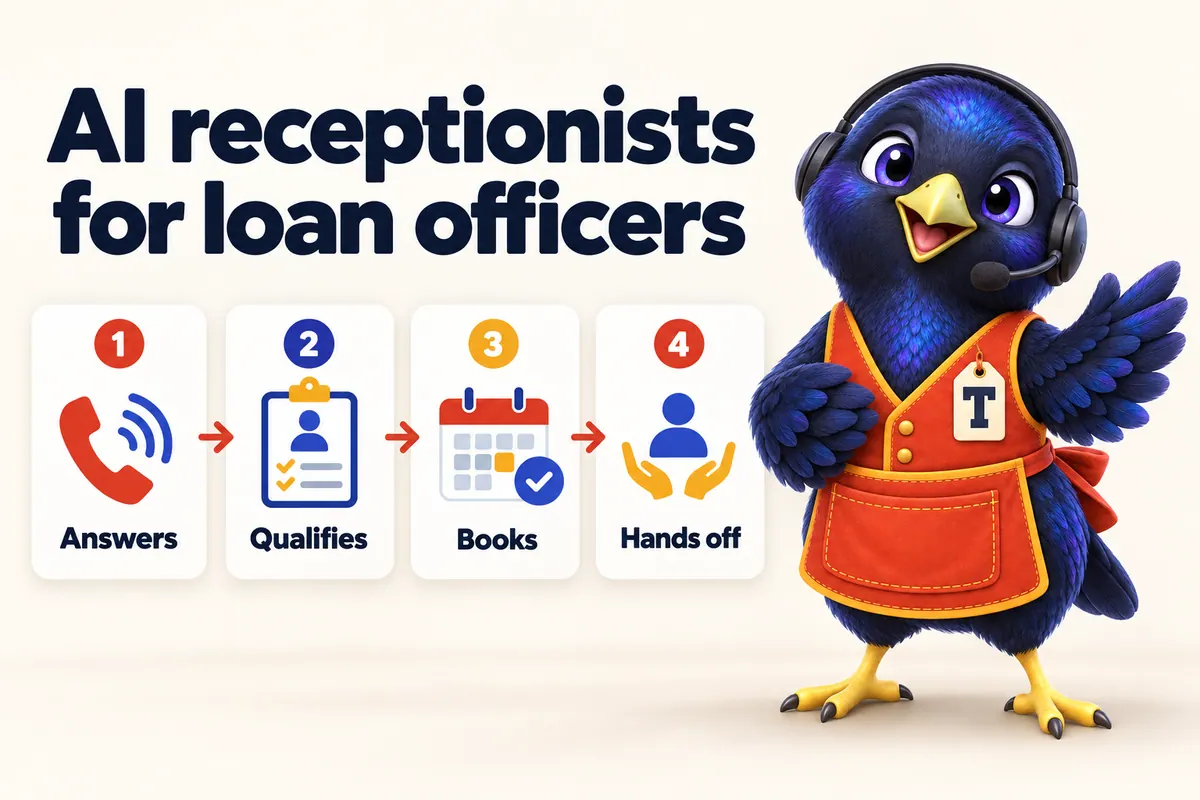
It handles the first conversation. In order: answers within a ring or two, introduces itself as an AI assistant for your team (with a recording notice if you record), works out what the caller needs, answers general questions from approved content, collects name, contact details, goal and timeline, and then books an appointment, transfers the call, or takes a message.
Source: Illustrative example, not a client result or industry benchmark
Show the data table
| Stage | Count | Of first stage |
|---|---|---|
| Calls received after hours | 20 | 100% |
| Answered by the AI | 20 | 100% |
| Details collected | 14 | 70% |
| Booked a call with the LO | 7 | 35% |
| Asked for a callback instead | 4 | 20% |
The numbers in that chart are made up to show the shape, not a promise. What is real is the mechanism: without an answer, those callers hit voicemail, and many move on to the next name on the list.
What must it never do?
An AI receptionist must never quote rates, payments or fees; pre-approve, approve or decline anyone; give personalised loan, tax or legal advice; collect Social Security numbers or account numbers; or pretend to be a human.
| The AI can | The AI cannot |
|---|---|
| Explain how FHA, VA or conventional loans generally work | Say which loan a caller qualifies for |
| Share your hours, service area and licensed states | Quote a rate, payment or closing cost |
| Collect contact details and the caller's goal | Collect SSNs, account numbers or documents |
| Book an appointment on your calendar | Promise approval or timelines |
| Transfer to you or a teammate | Pretend to be a person |
What consent and disclosure rules apply?
Three areas matter most. This is general information; your compliance team approves the configuration.
- AI disclosure. Tell callers they are speaking with an AI assistant. It is honest, increasingly expected by regulators, and avoids misleading anyone.
- Call recording. Some states require all parties to consent to recording, including California, Florida, Illinois, Pennsylvania and Washington. A short notice at the start of the call (“this call may be recorded”) is the usual approach.
- Outbound calls. Automated or AI-voiced outbound calls are governed by the Telephone Consumer Protection Act and generally need prior express consent. An inbound receptionist avoids most of that; if you want outbound reminders, get consent first.
Fair-lending consistency is a fourth, quieter benefit: every caller gets the same approved answers and the same path to a licensed loan officer.
How should the hand-off to a human work?
The hand-off is where an AI receptionist succeeds or fails. Decide in advance when it transfers (caller asks for a person, a rate or approval question, an upset caller, an existing client with an active loan), who it transfers to, and what happens when nobody is available (a booked callback rather than voicemail). After every call, a summary should land in your CRM: who called, what they wanted, what was promised.
- Calls arriving
- Calls the LO can take live
Source: Illustrative example of a typical week for a solo loan officer, not measured data
Show the data table
| Label | Calls arriving | Calls the LO can take live |
|---|---|---|
| 7–9 am | 3 | 1 |
| 9–12 | 6 | 3 |
| 12–2 | 4 | 2 |
| 2–5 | 6 | 3 |
| 5–8 pm | 7 | 2 |
| 8–11 pm | 4 | 0 |
The gap between those two bars is the opportunity. The evening slots, when many borrowers finally have time to call, are often the ones nobody answers.
How do you set one up well?
Good results come from preparation, not from the model. Here is the order we follow.
- Write the knowledge base. Programs you offer, service area, licensed states, hours, how to apply, what documents to gather. Keep each answer short and accurate.
- List the forbidden topics. Rates, approvals, fees, advice. Write the exact polite redirect for each.
- Define hand-offs. Transfer rules, backup person, callback booking.
- Write the greeting and disclosures. Have compliance approve them.
- Connect the calendar and CRM. Test a booking end to end.
- Run test calls. Ask awkward questions on purpose, including rate questions.
- Review weekly. Read summaries, fix answers, add questions you missed.
What does it cost, and how do you judge it?
AI receptionists are usually priced as a monthly fee with included minutes, a per-minute rate after that, and a set-up fee. Ours is $179 a month with 400 minutes included, $0.18 per extra minute and a $299 set-up fee, and it is included in AI Engine Complete (all channels) ($329/mo).
Ways to cover calls you cannot answer
Voicemail
Pros
- Free
- Simple
Cons
- Many callers hang up
- No booking
- Slow follow-up
Best for: Very low call volume
Human answering service
Pros
- A person answers
- Good for complex messages
Cons
- Per-call or per-minute costs
- Limited mortgage knowledge
- Usually takes messages only
Best for: Teams wanting a human voice at all times
AI receptionist
Pros
- Answers instantly, any hour
- Books your calendar
- Consistent approved answers
Cons
- Needs careful set-up and review
- Must hand off anything licensed
Best for: LOs who miss calls during closings and evenings
Judge it by what you can observe: how many calls it answered that would have gone to voicemail, how many appointments it booked, how clean the hand-offs were, and what callers said. Be wary of any provider promising a specific accuracy percentage or lead lift; those numbers depend on your callers and your content.
What should the knowledge base include?
The knowledge base is the AI receptionist’s entire world. It should be short, accurate and written in your voice. A good starter set covers:
- Who you are: your name, company, NMLS IDs, licensed states and service area.
- What you offer: the programs you actually originate, each with a two- or three-sentence general description and no terms or rates.
- How it works: the steps from first call to closing, and what documents borrowers usually gather.
- Practical details: office hours, how to book, how to send documents securely, how long things usually take in general terms.
- Hand-off rules: who to transfer to, when, and what to do when nobody is available.
- Forbidden topics and redirects: the exact polite sentence for rate, approval, fee and advice questions.
Keep answers short. Callers want one clear sentence and a next step, not a lecture. Review the knowledge base whenever you add a program or change how you work.
How should calls be summarised for the loan officer?
The summary is what turns an answered call into a useful lead. Ask for the same fields every time so you can scan them quickly:
- Caller name and best contact details, with consent noted.
- Goal (purchase, refinance, cash-out, VA, investment, reverse) and rough timeline.
- Property location and whether they have a real estate agent.
- What the AI told them and what it promised (for example “Jordan will call tomorrow at 2”).
- Anything urgent or sensitive that needs a personal touch.
- A link to the recording, if recording is enabled and disclosed.
Summaries should land in your CRM on the contact’s record, with a task for the promised follow-up. That way nothing depends on someone remembering to check a separate app.
What are the common failure modes?
Most problems with AI receptionists come from configuration, not technology.
- Too much knowledge. Loading long documents leads to long, rambling answers. Short approved snippets work better.
- No clear hand-off. If callers cannot reach a person when they ask, frustration builds quickly.
- Unclear disclosures. Burying the AI disclosure or recording notice erodes trust and can create compliance issues.
- Rate leakage. If the forbidden-topic rules are vague, the AI may try to be helpful with numbers it should never give.
- No review loop. Without weekly review, small mistakes repeat.
How does it fit with the rest of your follow-up?
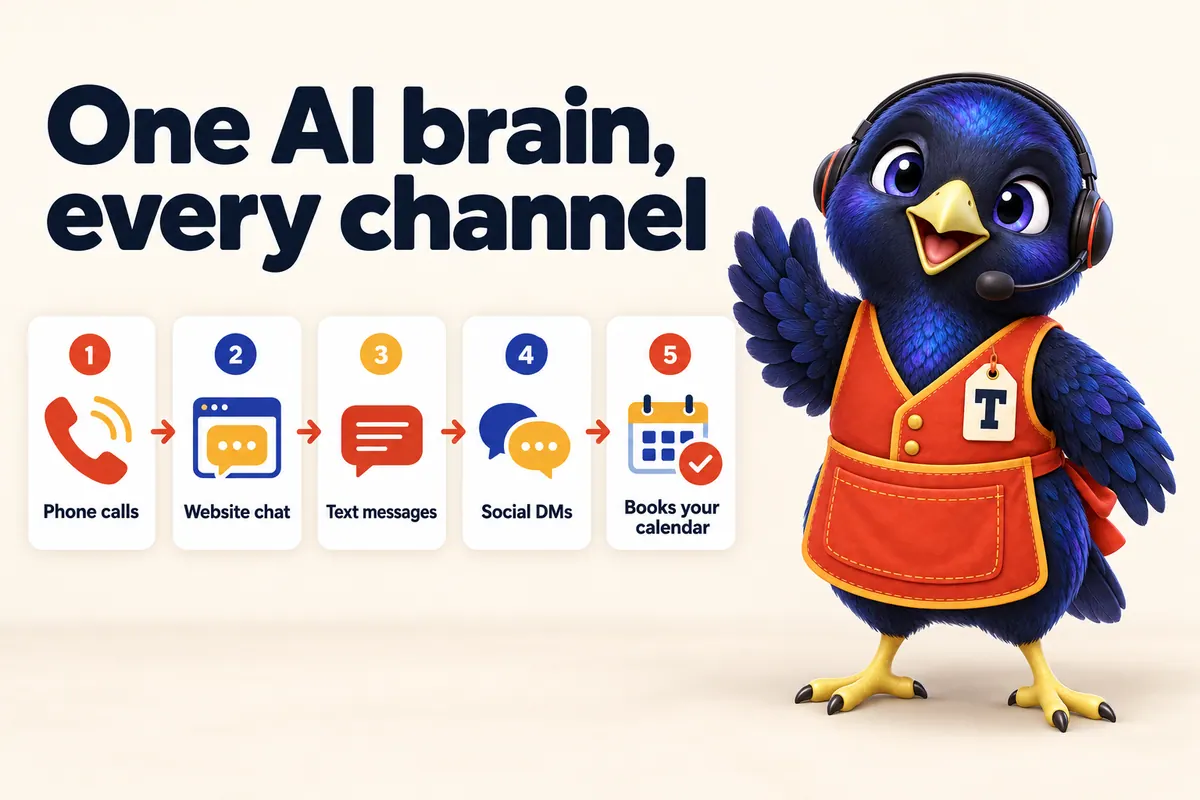
An AI receptionist works best as one part of a follow-up system. A missed call can trigger a “sorry we missed you” text (with consent), the booking lands on your calendar, the summary lands in your CRM, and the same assistant can answer the follow-up text when the caller replies. When website chat, SMS and social DMs share the same knowledge base, borrowers get consistent answers no matter how they reach you.
Questions to ask any AI receptionist provider
Before you sign up for any AI receptionist, ask the provider these questions and get the answers in writing.
- How do you prevent the AI from quoting rates, fees or approvals?
- How is the AI disclosure worded, and can our compliance team change it?
- How are recordings stored, who can access them, and can we delete them?
- What happens when the AI does not know an answer?
- How do transfers work, and what happens after hours?
- Where do summaries and contact details go?
- What is included in the monthly price, and what costs extra?
- Can we pause it instantly if something goes wrong?
The bottom line
An AI receptionist is a coverage tool. It makes sure the phone is always answered politely and that the right conversations reach you, with details already captured. Configure it with clear guardrails, disclose that it is AI, follow consent rules, and keep every licensed decision with a licensed person. Read more about how ours handles calls on the AI Receptionist page, or see how the same brain answers chat, texts and DMs.
Frequently asked questions
What is an AI receptionist for a loan officer?
It is a voice AI that answers your business line, introduces itself as an AI assistant for your team, answers general questions from content you approve, collects the caller's details and goal, and books an appointment or transfers the call to a person.
Can an AI receptionist quote mortgage rates?
It should not. Rates depend on the borrower's details, change daily and carry advertising rules. A well-configured receptionist declines rate questions and offers a call with the loan officer.
Is it legal to use AI to answer calls?
Answering inbound calls with AI is generally permitted, but you should disclose that the caller is speaking with an AI, follow call-recording consent laws, and avoid any misleading statements. Outbound AI calls are a different matter and require prior express consent under the TCPA.
Do callers dislike talking to AI?
Callers mostly dislike waiting and voicemail. A short, honest greeting that solves the immediate need (a booked call, an answer, a transfer) tends to be accepted. Always offer a person.
What happens when the AI does not know the answer?
It should say so, take a message or transfer, and log the question so you can add an approved answer.
Can it book appointments directly on my calendar?
Yes, if it is connected to your calendar. It offers open times and confirms the booking by text or email.
Does it work after hours only?
You choose. Many loan officers forward calls to it after hours and when they do not answer during the day.
How is call data stored?
Summaries, and recordings if you enable them with disclosure, go to your CRM. Choose a provider that does not sell data and lets you delete recordings.
How much does an AI receptionist cost?
Pricing is usually a monthly fee with included minutes plus a per-minute rate after that, and a set-up fee. See our pricing page for ours.
Will an AI receptionist replace my assistant?
It covers the calls nobody can answer and the repetitive first questions. Most teams find their people spend more time on borrowers who are ready, not less.
Sources
- FCC: Telephone Consumer Protection Act (read 2026-10-19)
- MBA Chart of the Week: Mortgage Industry Employment (September 2025)
- Freddie Mac Primary Mortgage Market Survey (2026-10-15)
Statistics are quoted with source and date. Mortgage Website Shop is a website and marketing provider, not a lender; this article is general information, not legal or financial advice.