
Template vs custom mortgage website: which should a loan officer choose?
Template vs custom mortgage website: cost, time to launch, flexibility, risk and SEO compared, with published price ranges.
 Ines CallowayDesign lead, Mortgage Website ShopPublished · Updated · 5 min read
KEY TAKEAWAYS
- Templates win on time to launch, price certainty and the ability to see the result before you buy.
- Custom builds win on flexibility, unusual integrations and a completely unique brand experience.
- Search engines reward useful, fast, well-structured pages, not custom code.
- A done-for-you template, rewritten and rebranded, gives most loan officers custom-looking results at template speed.
Choose a template if you want a professional mortgage site quickly at a predictable price and you value seeing the finished result before you buy. Choose a custom build if you need something no template can do and you have the budget and patience for it. For most individual loan officers, a mortgage-specific template that is rewritten and rebranded for them is the better trade.
Here is the reasoning, with published price ranges and a checklist to decide.
low end of freelancer website builds, upfront
Morty LO website cost guide, read 2026-10-19
high end of custom agency builds, upfront
Morty LO website cost guide, read 2026-10-19
business days to launch a done-for-you template after onboarding
Mortgage Website Shop Shelf plan
What is the difference between a template and a custom site?
A template site starts from a finished, tested layout and adapts it: your colours, logo, photos, copy and program pages. A custom site starts from a blank page: strategy, wireframes, design, development, then content. Both can look excellent. The difference is how much is invented from scratch, and therefore how much it costs and how long it takes.
How do cost and time compare?
Custom builds front-load cost; templates spread it out.
Source: Freelancer and agency ranges from Morty's LO website cost guide; template figure is our Shelf launch fee. Read 2026-10-19.
Show the data table
| Label | Upfront (USD) |
|---|---|
| Done-for-you template | 449 |
| Freelancer (low) | 1,000 |
| Freelancer (high) | 5,000 |
| Agency (low) | 3,000 |
| Agency (high) | 15,000 |
Source: Illustrative ranges based on common project timelines; individual projects vary
Show the data table
| Item | Value |
|---|---|
| Done-for-you template | About 1–2 weeks |
| Freelancer | 3–8 weeks |
| Custom agency | 6–16+ weeks |
Which one is better for SEO?
Neither, inherently. Search engines reward useful, fast, well-structured pages. A template with original, program-specific content, clean structure, schema and fast pages competes on equal terms with a custom site. A custom site with thin content and a slow, script-heavy build can rank worse. The variable that matters is the quality of the work, not whether the layout was invented for you.
What are the real pros and cons?
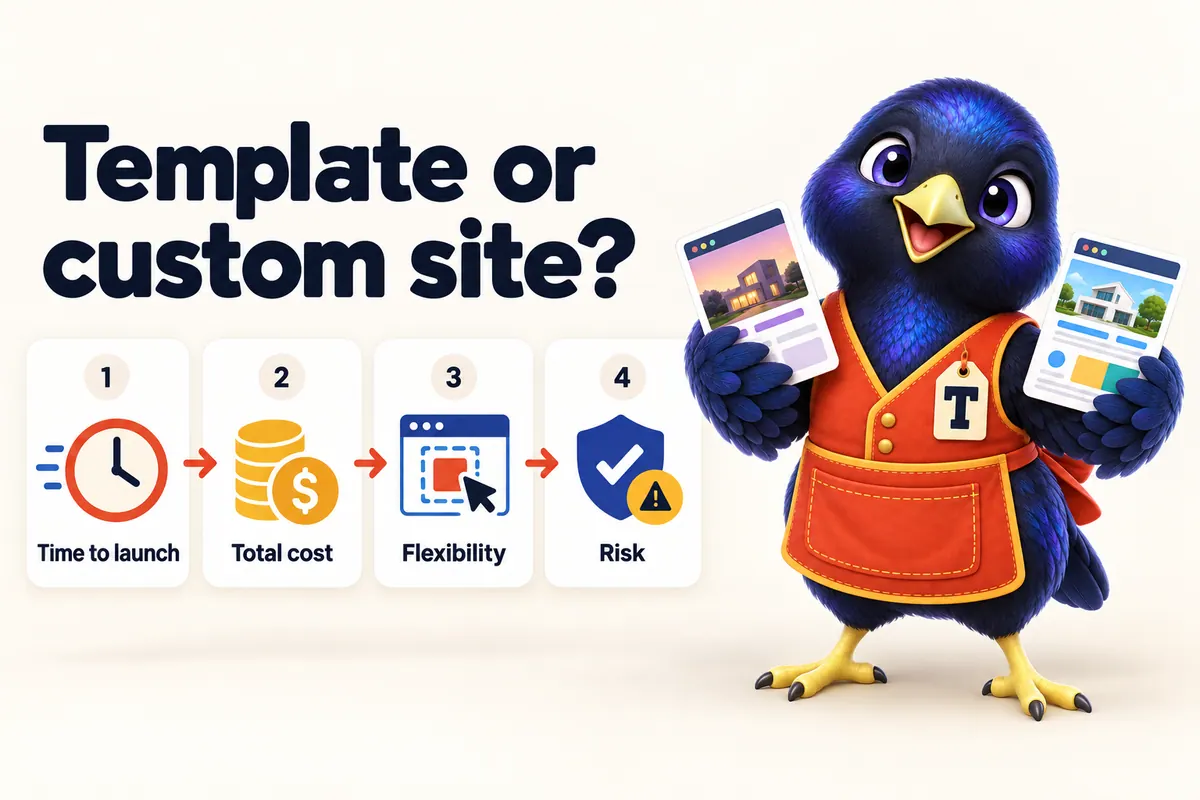
Template or custom?
Done-for-you template
Pros
- See it live before buying
- Launch in about a week
- Predictable monthly cost
- Tested for speed and accessibility
Cons
- Changes stay within the design
- Not unique at the layout level
Best for: Individual LOs and small teams who want results fast
Custom build
Pros
- Anything is possible
- Unique brand experience
- Complex integrations
Cons
- High upfront cost
- Long timelines
- More risk of scope creep
Best for: Larger teams with specific needs and budget
A decision checklist
| Question | Points to template | Points to custom |
|---|---|---|
| Do you need to launch within a month? | ☑ | |
| Is your budget under the agency range? | ☑ | |
| Do you need a deep LOS or POS integration? | ☑ | |
| Do you have a brand team with strict guidelines? | ☑ | |
| Do you want to see the finished site before paying? | ☑ | |
| Will many brands or branches share one platform? | ☑ |
How do you make a template feel custom?
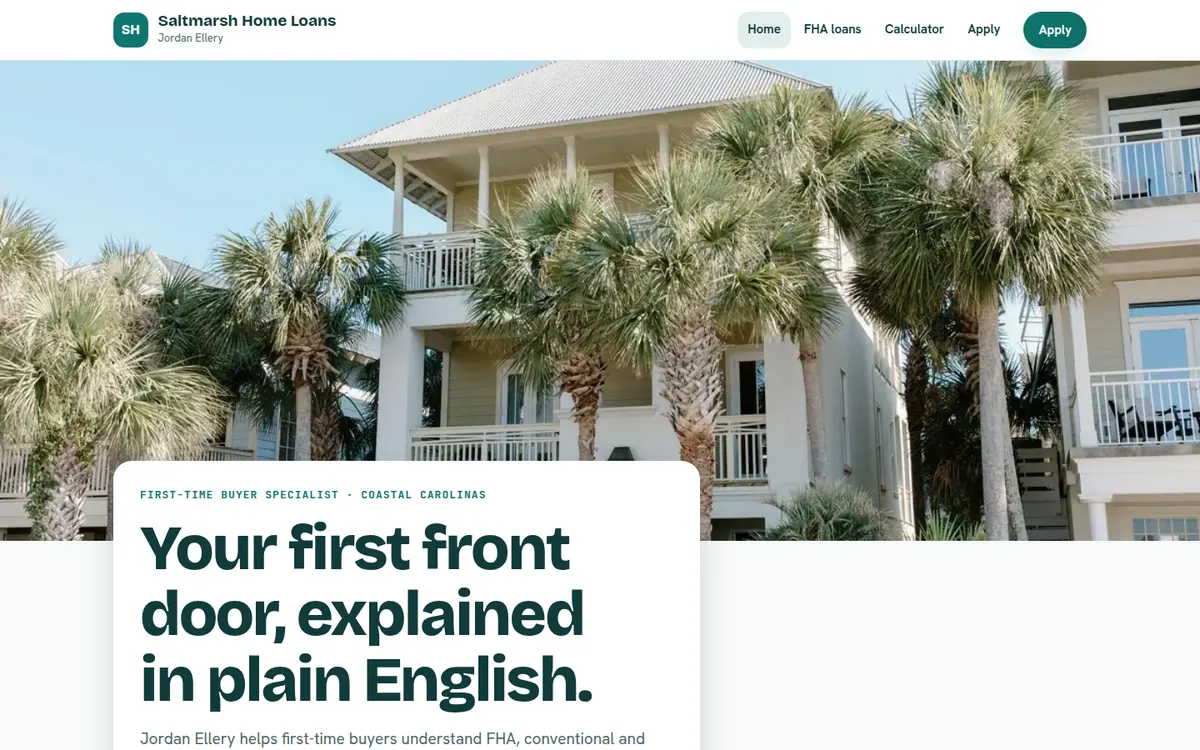
The parts that make a site feel like yours are not the grid. They are your photography, your voice, your story, your programs and your reviews. A good template provider rewrites every page, replaces every sample image, adapts colours with contrast checks, and builds your compliance details in. Ask any provider to show you two live client sites on the same template; if you cannot tell, the template is doing its job.
What do loan officers usually underestimate?
Whichever route you choose, three things take longer than expected.
Content. A credible mortgage site needs thousands of words: home, about, program pages, calculator explanations, FAQs. Custom projects often stall waiting for copy. Done-for-you templates include the writing, which is a large part of why they launch quickly.
Compliance review. Your company’s compliance team needs to approve the site. Templates with a pre-built compliance block tend to move through review faster because the elements are already in familiar places.
Photography. Professional headshots and local imagery make a site feel personal. Book a photographer early, or ask your provider to source licensed photos that fit your market.
How much design freedom do you really need?
Most loan officers need a site that looks professional, loads fast, explains programs clearly and makes it easy to act. Those needs are well served by a strong template. True design freedom matters when your brand is a differentiator in itself (for example a large team with a distinctive identity), when you need unusual features, or when you serve a niche that no template addresses.
A useful test: list the three things you want visitors to feel and the three actions you want them to take. If a template already delivers those, design freedom adds cost without adding results.
What questions should you ask an agency?
If you do go custom, ask these before signing:
- What exactly is in scope, and how are changes priced?
- Who writes the content, and how many rounds of revisions are included?
- Who owns the code, the design files, the domain and the content?
- What will ongoing hosting, maintenance and updates cost?
- How will the site be tested for speed, accessibility and mobile use?
- Can we see live mortgage sites you have built and speak to those clients?
- What happens if the project runs late?
What questions should you ask a template provider?
And if you go with a template, ask these:
- Can I see live examples, including two clients on the same design?
- Who writes my pages, and will sample copy be replaced entirely?
- How much can colours, fonts, sections and photos change?
- How do you handle my NMLS, licensing and Equal Housing details?
- How fast are the pages, and how do you measure it?
- Is there a minimum term, and what happens when I cancel?
- Who owns my domain, content and leads?
Can you combine both approaches?
Yes, and many businesses do. Start with a done-for-you template to get a professional site live quickly, learn what your borrowers respond to, then invest in custom features where the data shows they would help. Because your domain and content are yours, a later custom build can reuse everything you have already published.
What does the launch process look like with each?
The day-to-day experience of each route is very different, and it is worth knowing what you are signing up for.
With a done-for-you template, you typically pick a design, fill in an onboarding form (NMLS details, programs, photos, tone of voice), join a kickoff call, and receive a private preview within days. You and your compliance team request changes, the provider makes them, and the site goes live. Most of your involvement is reviewing, not producing.
With a custom build, you usually start with discovery workshops and a sitemap, then review wireframes, then design concepts, then a development build. Content is often written in parallel or supplied by you. Each stage has its own review and approval, which is where timelines stretch. The result can be excellent, but it asks more of your time.
How do ongoing costs compare?
Upfront cost is only part of the picture. Templates from done-for-you providers usually include hosting, updates, support and some content in the monthly plan, so the ongoing cost is predictable. Custom builds often need a separate hosting arrangement and a maintenance retainer or hourly support for changes. Before choosing, estimate three years of total cost for both routes, including the changes you expect to make, and compare those totals rather than the launch price alone.
What happens if your needs change?
Needs change: you may join a new company, add states, start a team or shift focus to a new loan program. With a template, these changes are usually handled within your plan’s revision rounds or as add-ons, and the structure already anticipates them. With a custom build, changes outside the original scope are quoted separately. Neither is wrong, but it is worth asking each provider how they handle the three most likely changes in your next year.
The bottom line
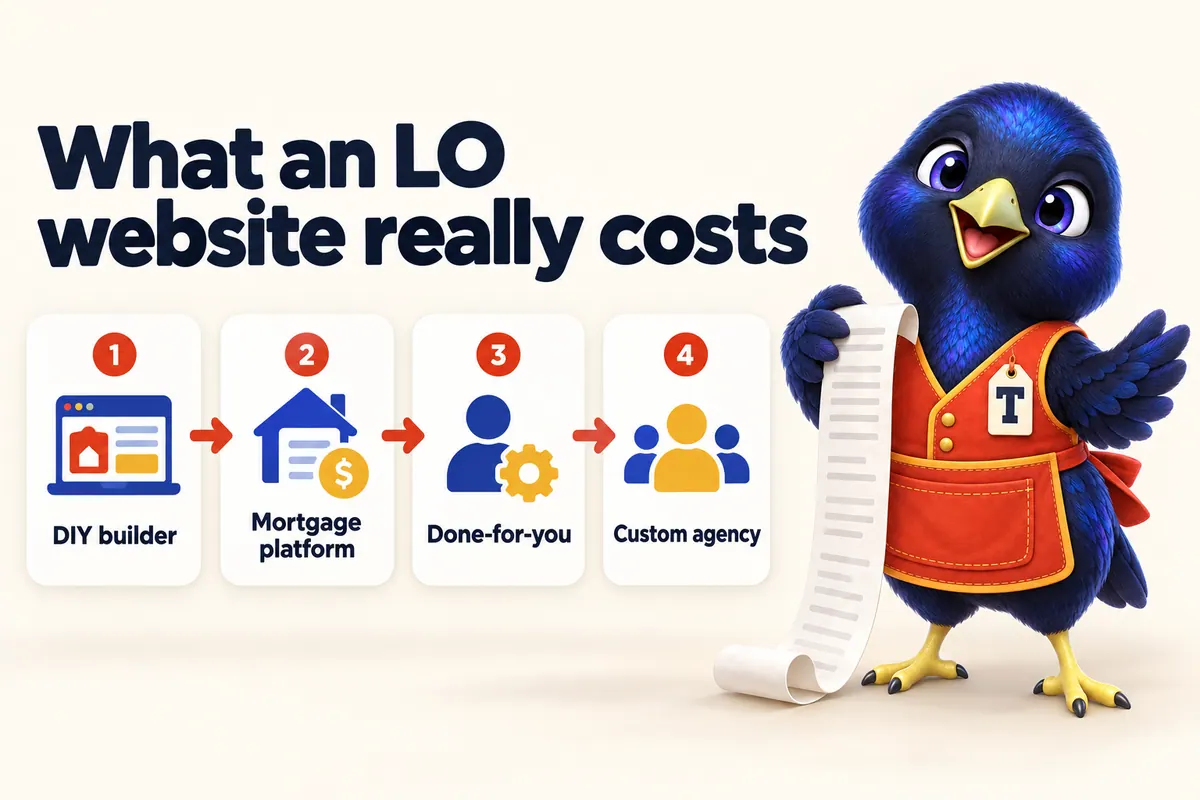
Templates are a shortcut, not a compromise, when they are mortgage-specific and done for you. Custom builds earn their cost when you genuinely need what they offer. Start with the question of what you need in the next six months, not what would be nice in three years. Browse the catalogue, compare plans, or read our guide to what an LO website really costs.
Frequently asked questions
Is a template website good enough for a loan officer?
For most individual loan officers, yes, if it is mortgage-specific, rewritten for you, fast and compliant. The template provides a proven structure; your content and branding make it yours.
Will my template site look like everyone else's?
Not if it is rebranded and rewritten. Colours, photography, logo, copy and program mix change the experience far more than the underlying layout.
When does a custom website make sense?
When you need unusual functionality, deep integrations with your LOS or POS, a large multi-brand presence, or a brand experience that no template can carry, and you have the budget and time.
How much does a custom mortgage website cost?
Public guides put freelance builds at roughly a thousand to several thousand dollars and agency builds from several thousand to fifteen thousand dollars or more upfront, before ongoing retainers.
How long does each take?
Done-for-you templates can launch within about a week of onboarding. Custom builds typically take weeks to months, depending on scope and approvals.
Does a custom site rank better in Google?
Not inherently. Rankings depend on content, technical quality, local signals and reputation.
Can I start with a template and go custom later?
Yes, as long as you own your domain and content. Many businesses start with a template and commission custom work once they know what they need.
What should I ask a template provider?
Who writes the content, how much the design can change, who owns the domain and content, how fast the pages are, and how cancellation works.
Are free templates a good idea?
Free general templates save money but leave the mortgage content, calculators, compliance placement and speed work to you.
What is the biggest risk with custom builds?
Scope and timeline creep. Get a clear statement of work, milestones, and ownership terms in writing.
Sources
- Morty: LO website costs (read 2026-10-19)
- Wix premium plans (read 2026-10-19)
Statistics are quoted with source and date. Mortgage Website Shop is a website and marketing provider, not a lender; this article is general information, not legal or financial advice.